Can a Vision-Language Model See Our Isaac Sim Course Better Than YOLO?
Written by Isabella Wu, Software Co-lead, October 15, 2026.
Vision-language models (VLMs) can look at a camera image and tell you about it in plain language, and recent research has handed them the planning for underwater robots. So we asked the obvious question: could one tell us something our YOLO detector can't, like that a sign is half hidden, that we're lined up on the wrong opening, or that a task the robot called finished never happened? We ran four tests over the same 397 simulated frames. Neither an 8-billion nor a 30-billion-parameter open model found the course objects reliably once we stopped showing it YOLO's detections, and the bigger model did not close the gap.
“If you show a model a hint, you have to test it without the hint too.”
Backstory
Start with what Barracuda already does. The ZED stereo camera feeds a YOLO object detector, the detections become 3D landmarks in our factor-graph state estimator, and a behavior tree plans each task for an MPPI controller to fly.
A bounding box is good at one question: what is in the frame, and where? Ask it anything harder and it goes quiet. Is the gate half hidden behind a pipe? Are we lined up with the wrong opening? Did the task the behavior tree just checked off actually happen? A human operator answers those at a glance. YOLO can't answer them at all.
This study started with a paper: UnderwaterVLA [1], a dual-brain vision-language-action architecture for underwater navigation. A large "brain" model looks at the scene and breaks the mission into sub-goals; a smaller onboard "cerebellum" model reads each camera frame and answers in a fixed format: which way to move, how fast, and whether the current step is done. That last part caught our attention. Small, structured answers from a vision model, including a plain "step done" flag, could sit on top of a robot that already works instead of replacing it.
We adapted the idea rather than copying it, for two reasons. At RoboSub the vehicle runs untethered and fully autonomous, with no link to an outside computer, so any vision model has to fit onboard. And Barracuda already plans and controls well with a behavior tree and MPPI, so the interesting question was never whether a VLM can drive. It was whether it can see. That is the claim we tested: does an onboard-sized VLM see our course well enough to trust with any of these judgments? (The paper's "step done" flag became our task-completion check, further down.)
Project Description
Think of this as an eye exam. Before you let anyone advise the pilot, you check their eyesight. Our hypothesis was that a VLM could add scene-level judgments on top of YOLO, as an advisor at the behavior tree's decision points and never inside the control loop. To earn that job, it had to pass three tests:
1. It sees the course on its own. Nobody reads the chart for it. Without YOLO's list, it should still report the gate elements and signs that YOLO finds.
2. What it adds is true. When it says something is hidden, out of reach, or dangerous, the frame should agree.
3. It answers in time. A few seconds is fine at a decision point. Inside a control loop, a few seconds is a crash.
Method
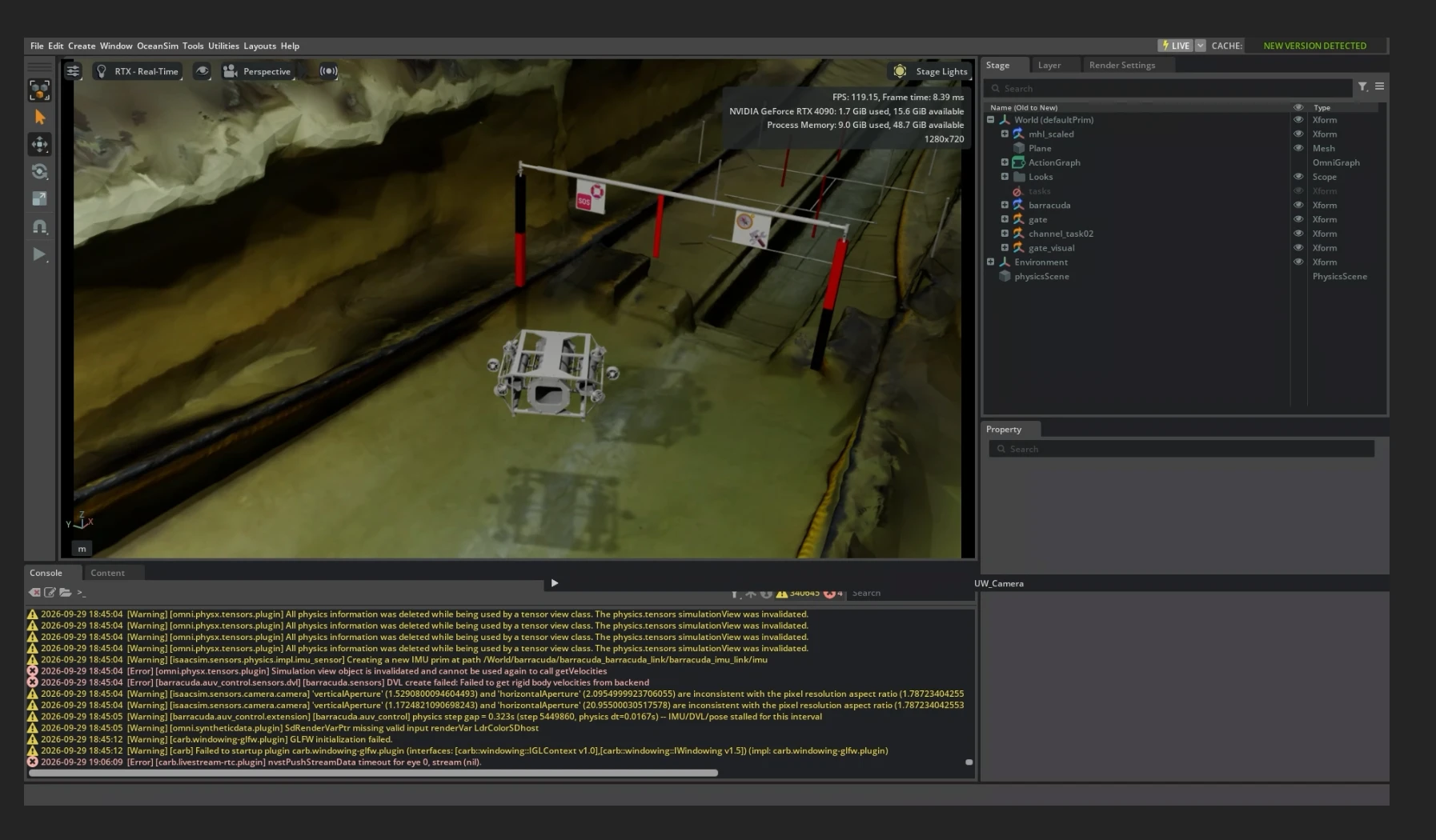
1. Record synchronized frames and detections. We flew Barracuda's full autonomy stack through Isaac Sim: find the gate, pass through it, try the slalom, come home through the gate. A small ROS 2 recorder held camera frames by timestamp and matched each YOLO detection message to the frame with exactly the same stamp (easy, because our detector copies the image header onto its output). Frames where YOLO saw nothing stayed in as negatives. One mission gave us 397 frames at about 2 frames per second.
2. Ask for an answer you can grade. For every frame the model had to return one JSON object: each visible object with its visibility (visible, partially occluded, or not visible), whether it could be reached from the current heading, and where it sat in the image, plus relations like "approaching the wrong side of the gate" and any hazards nearby. An answer that didn't parse counted as unusable. A behavior tree can't act on a nice paragraph.
3. Test two model sizes, locally. We used Qwen3-VL at 8 billion parameters and a 30-billion-parameter mixture-of-experts version that wakes up about 3 billion of them per answer, both squeezed to 4-bit and served on the team's RTX 4090. Local mattered: a submerged vehicle can't phone a data center.
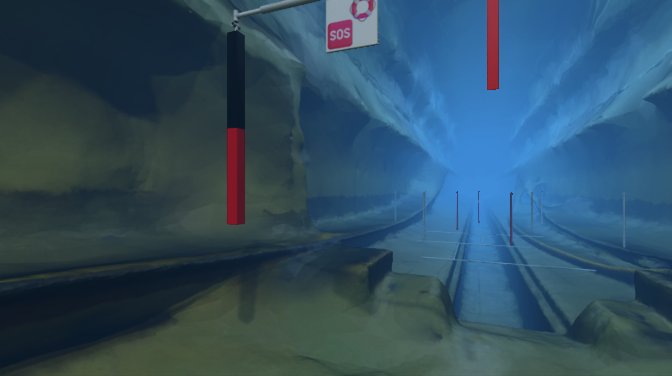
4. Run every model prompted and blind. This is the cover-one-eye part of the exam. Both conditions sent the same image, the same task ("gate traversal"), the same list of allowed object names, and the same answer format. The prompted condition added one line: YOLO's detections for that frame, with each object's confidence and rough position. For the frame at the top of this post it read: Object detector output: gate (score 0.19, center); search_rescue (score 0.68, center). That is how you would deploy it. The blind condition left the line out, so the model had to find everything itself. Compare the two and you learn what the model sees versus what it was told.
The VLM never controlled the vehicle. YOLO, the behavior tree, and the controller flew Barracuda the whole mission, exactly as they do in competition. The VLM only answered questions about the recorded frames afterward, so these results grade its eyesight, not Barracuda's performance.
Results
Each row is one run over the same 397 frames. "Found by both" counts objects that YOLO and the VLM both reported in the same frame.
| Run | Usable answers | Sec / frame | Found by both | VLM only | YOLO only | Role signs (YOLO: 45) |
|---|---|---|---|---|---|---|
| 8B, prompted with YOLO | 92% | 3.75 | 197 | 47 | 8 | 46 |
| 8B, blind | 61% | 4.33 | 43 | 288 | 63 | 2 |
| 30B, prompted with YOLO | 60% | 3.61 | 70 | 268 | 99 | 19 |
| 30B, blind | 54% | 3.37 | 21 | 313 | 54 | 0 |
The prompted model was mostly repeating YOLO. Here is the habit to watch for: seeing high agreement and calling it understanding. With YOLO's list in the prompt, the 8B model agreed with YOLO on 197 labels. Cover the hint and agreement fell to 43. Most of that agreement was the model reading the answer key.
Labels found by both YOLO and the VLM
On their own, neither model found the course objects. YOLO spotted the gate's role signs in 45 frames. Blind, the 8B model found them in 2 and the 30B model in none. Instead, both described the room: pool wall, water surface, floor. Accurate, as far as it goes. Not what we asked.
A bigger model did not close the gap. The 30B model copied YOLO less and reported spurious hazards about half as often, which is something. Blind, though, it found even fewer course objects, and most of its unusable answers put objects at positions our format doesn't allow, like "top-left". Bigger models, it turns out, also color outside the lines.
Latency rules out the control loop. Three to four seconds per frame on a desktop RTX 4090, and slower still on the vehicle's embedded computer. That's fine for an occasional question at a decision point. It's useless for steering.
What the Hazards Really Were
Both models kept reporting a tether and a diver near the vehicle. Our first reaction was "hallucination." Then we actually looked at the frames, which is always the better move.
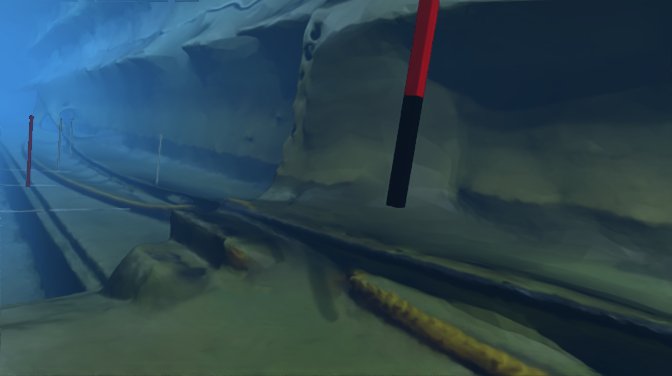
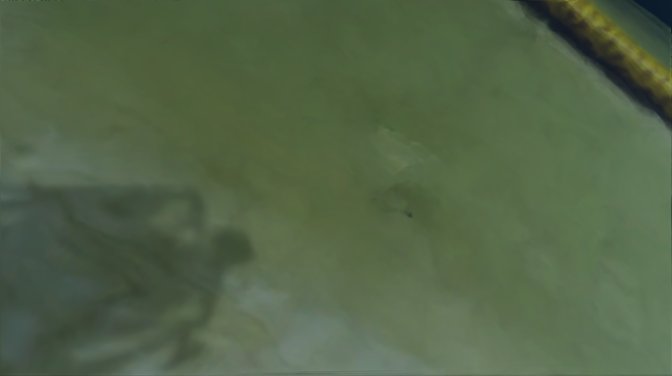
The "tether" is a real rope lying on the channel floor, so that one is fair. The "diver" is Barracuda's own shadow, frame and thrusters included. Neither answer came from nowhere. But picture a planner that trusts "diver on the left, not reachable": it would spend the whole run politely avoiding its own shadow.
There is a second culprit, and it's us. The prompt asked for "hazards such as walls, the surface, tether or divers", and the model's four most common answers were exactly those four. Examples in a prompt are hints too. Next time, ask for hazards without naming any.
Can It Tell When a Task Is Done?
Our behavior tree decides a task is complete from waypoints and time budgets, and now and then it's wrong. In this simulated mission, Barracuda went through the gate on the way out, just as it did autonomously to qualify at RoboSub 2026. The miss came on the last leg, return home: the simulated vehicle ended up against the channel wall, short of the gate, while the log cheerfully reported success.

So we tried the VLM as a second pair of eyes, with one yes-or-no question at the end of each task: did the vehicle pass through the gate? Shown only the last six frames (about four seconds of footage), the 8B model said "done" with 95% confidence before the vehicle had even reached the gate. Spreading nine frames across the whole task fixed that false alarm. On the outbound gate pass, though, which the vehicle did complete, the best it could manage was "can't tell." From a forward camera, a pass looks like the gate growing and then sliding out of frame, and the model never put that story together.
The footage did catch the false success. The model just couldn't be the one to call it, and that finding is now shaping how our mission planner decides a task is done.
Conclusion
What we found. On its own, a VLM that fits on our hardware could not reliably find the gate and its signs, and going from 8 to 30 billion parameters did not help. It mostly agreed with YOLO when we showed it YOLO's answers, and it was 95% sure of answers that were wrong. Recording the mission did surface one real problem, though: our mission planner reported a task as finished when it wasn't.
How we're using it. Four changes come out of this study:
1. YOLO stays Barracuda's eyes. Instead of adding a VLM, we're putting that effort into YOLO itself, starting with more training images of the gate from behind, which the vehicle sees on its way home.
2. Missions get a second check from the camera. The recorder we built saves every camera frame with YOLO's detections, so after a run we can see what the vehicle actually saw. That is how we caught the false "finished", and we're now changing how the planner decides a task is done.
3. Every new AI model takes the same test. The recorded frames, the scoring, and the blind runs are reusable. Any model we consider in the future gets tested on the same frames, with and without hints, before it goes anywhere near the vehicle.
4. The next round uses real water. We will check frames by hand instead of comparing against YOLO, repeat the test on real pool footage, and try again when models trained on underwater images become available.
References
[1] Z. Wang, Y. Zhu, Y. Yan, X. Tian, X. Shao, M. Li, W. Li, G. Su, W. Cui, and D. Fan, "UnderwaterVLA: Dual-brain Vision-Language-Action architecture for Autonomous Underwater Navigation," arXiv:2509.22441, 2025. arxiv.org/abs/2509.22441
[2] Qwen Team, Qwen3-VL vision-language models. github.com/QwenLM/Qwen3-VL
[3] RoboNation, RoboSub 2026 Team Handbook. robonation.org/programs/robosub